
By Hafid Abbas
Visiting Professor at Tsai Lecture Series Asia Center, Harvard University, 2006
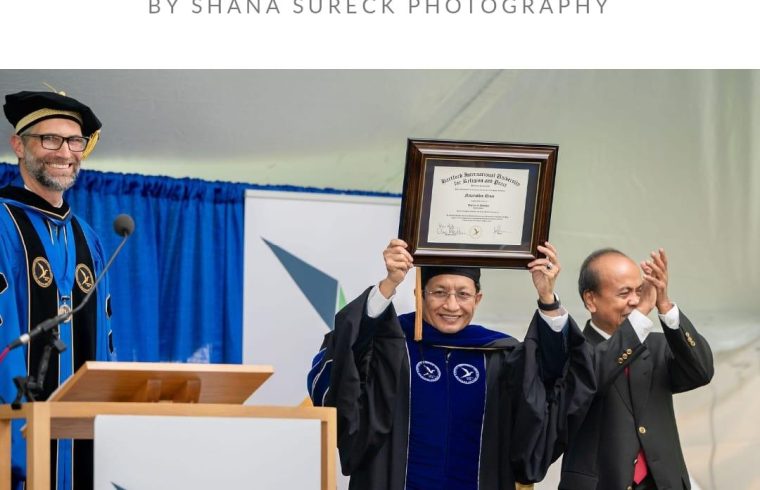
On May 15, 2025, Hartford International University for Religion and Peace (HIU) hosted a historic occasion that highlighted the deepening relationship between the United States and Indonesia. During the university’s commencement ceremony, HIU President Professor Joel Lohr conferred an Honorary Doctorate upon Professor Nasaruddin Umar, Indonesia’s Minister of Religious Affairs and Grand Imam of the Istiqlal Mosque. This act recognized not only his global religious leadership but also underscored a broader commitment to intercultural dialogue, democratic cooperation, and global peacebuilding.
More importantly, the event marked the soft launch of the Indonesia Study Center (ISC) at HIU—an initiative with far-reaching implications for academic exchange, diplomacy, and geopolitical strategy. While rooted in scholarship, the ISC emerges as a timely and strategic platform for catalyzing deeper U.S.-Indonesia relations and aligning with broader U.S. interests in the Indo-Pacific, the Muslim world, and the Non-Aligned Movement (NAM).
Under such circumstances, these are some realities for a strategic platform for U.S.-Indonesia partnership in a changing global order.
First is Indonesia’s global significance is multifaceted. As the world’s fourth most populous nation, the third-largest democracy, the largest Muslim-majority country, and a member of the G20, Indonesia holds unique geopolitical leverage. Its leadership within ASEAN, the Organization of Islamic Cooperation (OIC), and NAM makes it a central player in addressing key global and regional issues.
Amid rising geopolitical competition, particularly with China’s increasing influence across the Indo-Pacific and beyond, the U.S. sees Indonesia as a stabilizing force and a potential counterbalance. Indonesia’s consistent advocacy for neutrality, multilateralism, and peace aligns with American strategic goals—making it a natural partner for reinforcing democratic values, promoting sustainable development, and advancing global peace and security.
Second, the Indonesia Study Center at HIU is not simply an academic project—it is a forward-looking think tank and cultural bridge. Its purpose extends far beyond classroom learning; it aims to become a hub for diplomatic engagement, cultural exchange, and collaborative problem-solving on global challenges.
As a platform for U.S.-Indonesia cooperation, the ISC seeks to: Deepen mutual understanding between the two nations; Support ASEAN’s centrality in regional governance; Engage constructively with the OIC and NAM; and, Counterbalance rising authoritarianism and geopolitical competition in the Indo-Pacific
This center aligns with the goals of the U.S.-Indonesia Comprehensive Strategic Partnership launched in 2021, which aims to enhance cooperation in democratic governance, economic development, climate change, human rights, and regional security.
Third, the Indo-Pacific is now the geopolitical epicenter of global power dynamics, particularly as tensions rise in the South China Sea and over Taiwan. As both nations stress the importance of a “free and open Indo-Pacific,” the ISC can serve as an intellectual and diplomatic vehicle for exploring regional security challenges, such as maritime conflict, counterterrorism, and cyber resilience.
Indonesia’s own peacebuilding record—demonstrated in its role in mediating the Helsinki Accord in Aceh and its leadership in interfaith dialogue—offers models for conflict resolution. These experiences can enrich policy debates and strategies aimed at defusing tensions and promoting long-term stability throughout the Indo-Pacific.
Fourth, as the largest Muslim-majority country, Indonesia holds significant sway in the OIC, an organization representing nearly two billion Muslims globally. Indonesia’s religious diplomacy, rooted in tolerance, moderation, and dialogue, is a valuable counter-narrative to extremism and polarization.
Through the ISC, the U.S. and Indonesia can jointly promote interfaith understanding and collaborate on peace initiatives within the Muslim world. This includes educational exchanges, religious studies programs, and dialogue on human rights and pluralism—areas where Indonesia’s experience can have transformative global impact.
Next, the ISC also holds potential to reinvigorate engagement with the Non-Aligned Movement. Historically, Indonesia played a foundational role in NAM, hosting the landmark Bandung Conference in 1955 that laid the groundwork for a multilateral, non-bloc global order. Today, with NAM’s 118 member states, the organization remains influential, particularly in the Global South.
Indonesia’s consistent diplomatic neutrality and advocacy for sovereignty and development resonate with NAM’s core principles. The ISC can become a platform for policy dialogues and research aimed at addressing global inequalities, climate challenges, and conflict resolution—all from a perspective that values sovereignty and multilateral diplomacy.
Sixth, beyond geopolitics, the ISC will serve as a platform for cultural diplomacy. It will promote Indonesian language, arts, and traditions through language courses, exhibitions, and public events. These programs will not only enrich the academic community at HIU but also build broader public appreciation for Indonesia’s diverse cultural heritage.
It will also support scholarly collaboration by fostering joint research projects, academic conferences, and publications between U.S. and Indonesian institutions. Focus areas include democratization, religious tolerance, sustainable development, and climate policy—issues that are central to global discourse.
Furthermore, the center will act as a support network for Indonesian students in the U.S., assisting them with academic integration, personal development, and cultural adjustment. This people-to-people exchange is vital in cultivating future leaders who are globally conscious and diplomatically adept.
Seventh, the ISC also serves a quasi-diplomatic function by enhancing Indonesia’s soft power. It will reinforce Indonesia’s identity as a moderate, democratic, and peace-oriented Muslim-majority nation—an identity that is increasingly relevant in a fragmented global order. By promoting Indonesia’s democratic and pluralistic values, the center helps to reshape narratives around Islam, democracy, and development in the Global South.
Lastly, as a conclusion, the Indonesia Study Center at Hartford International University is more than a symbolic gesture—it is a strategic investment in one of the most important bilateral relationships in the 21st century. As the U.S. seeks to navigate a complex global environment marked by multipolarity, the rise of China, and the persistence of conflict, Indonesia offers a vital partnership grounded in shared values and mutual respect.
Through the ISC, both countries can address pressing regional and global challenges, while fostering the kind of academic, cultural, and diplomatic collaboration that defines enduring partnerships. In doing so, the ISC may very well become one of America’s most valuable think tanks in advancing its interests not only in Southeast Asia but across the Islamic world and the Global South.
This initiative marks a new chapter in U.S.-Indonesia relations—one that promises to shape regional dynamics and global diplomacy for years to come.(ABIM)


